-scaled.png)
-2048x1135-1.png)
When investing in a Solar Home Backup System, many homeowners focus only on battery capacity numbers without fully understanding what they mean. Terms like kW and kWh appear on every specification sheet, yet confusion between the two often leads to poor purchasing decisions. This guide provides a clear explanation of kW vs kWh, offers practical battery capacity explained insights, and shows how proper solar battery sizing ensures reliable blackout protection.
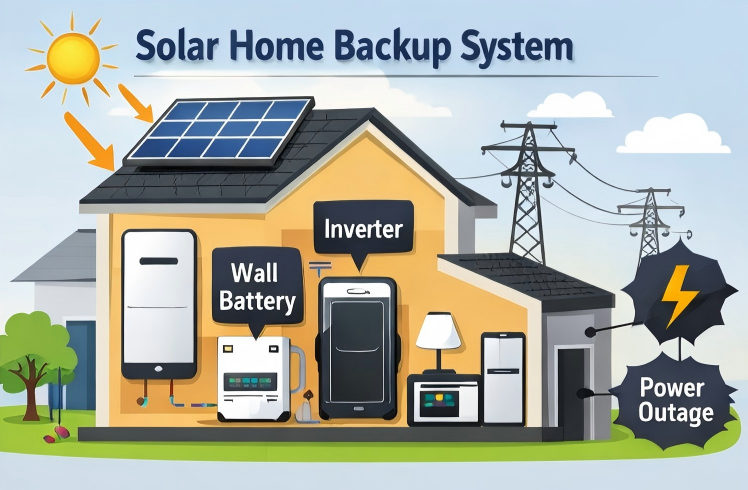
Table of Contents
What Is a Kilowatt (kW)? What Is a Kilowatt-Hour (kWh)?
A kilowatt (kW) is a unit of power. It measures the rate at which electricity is being used at a specific moment. For example, if an air conditioner requires 3 kW to operate, it means it needs 3 kilowatts of power continuously while running.
A kilowatt-hour (kWh), on the other hand, measures energy. It represents how much electricity is consumed over time. If a 1 kW appliance runs for one hour, it uses 1 kWh of energy.
In simple terms:
- kW = how fast electricity is used.
- kWh = how much electricity is used over time.
For any Solar Home Backup System, both numbers are critical. One determines whether appliances can start and run; the other determines how long they can operate.
kW vs kWh: The Critical Difference Between Power and Energy
The confusion between kW vs kWh often results in oversized expectations and undersized systems. A battery may have a large kWh rating, giving the impression of long backup duration, but if its kW output is too low, it cannot power heavy appliances. Conversely, high kW output with low kWh capacity may run devices powerfully—but only briefly. Proper Solar Home Backup System design requires balancing both. Understanding this difference transforms battery capacity explained from theory into practical planning.
How to Match Battery kW and kWh Ratings to Your Actual Home Usage
Matching kW and kWh ratings begins with understanding real household demand. A Solar Home Backup System must handle two essential factors: peak power demand (kW) and total daily energy consumption (kWh).
First, calculate your simultaneous appliance load. If your refrigerator (0.8 kW), lighting (0.5 kW), and water pump (1.2 kW) operate together, your system must supply at least 2.5 kW continuously. Add surge requirements for motor-based appliances.
Second, determine daily consumption. If your household consumes 20 kWh per day and you want 8 hours of backup, you need sufficient kWh storage to meet that demand.
For example, Hicorenergy’s residential storage solution, SI LV1, delivers up to 14.08 kW continuous output and scalable capacity from 10.24 kWh to 30.72 kWh per stack. This balance of power and energy makes solar battery sizing more flexible. Its modular lithium battery design allows homeowners to expand capacity as energy needs grow, making it highly suitable for a Solar Home Backup System in areas with unstable grids.
Using a solar battery sizing calculator can simplify this process, but understanding battery capacity explained ensures more accurate results.
Why Your “Big” Battery Won’t Power Your AC? The Hidden kW Problem Most Homeowners Miss
Many homeowners assume that a high kWh battery automatically guarantees whole-home backup. However, air conditioners and compressors require high startup power, sometimes 2–3 times their rated running power.
For example, a battery rated at 15 kWh may store enough energy to run an AC for several hours. But if its inverter output is limited to 3 kW, and the AC startup surge requires 5 kW, the system will fail to start it. This is a classic kW vs kWh misunderstanding.
In a properly designed Solar Home Backup System, the lithium battery and inverter must provide sufficient continuous and surge kW output. Products like Hicorenergy’s I-BOX 48100R, built with Tier 1 automotive-grade LiFePO4 cells and delivering over 6000 cycles, are engineered for both durability and stable power output. With over 95% round-trip efficiency and wide inverter compatibility, it supports reliable performance during outages.
Solar battery sizing must therefore prioritize both instantaneous power (kW) and stored energy (kWh). Ignoring either leads to underperformance during critical blackout moments.
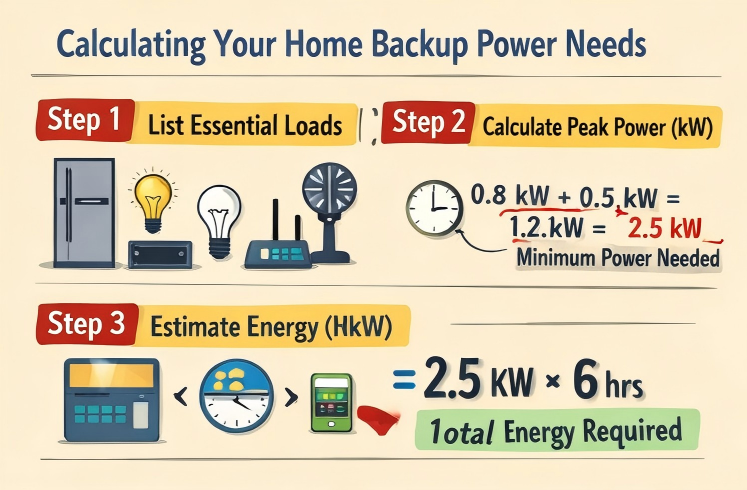
How to Calculate Your Home’s Backup Power Needs in 3 Simple Steps
Designing a Solar Home Backup System can be simplified into three practical steps:
Step 1: List Essential Loads
Identify appliances you want running during an outage—refrigerator, lights, Wi-Fi, fans, medical devices. Note their wattage ratings and convert to kW.
Step 2: Calculate Peak Power (kW)
Add the wattage of devices that may operate simultaneously. This defines your minimum required inverter and battery output rating.
Step 3: Estimate Required Energy (kWh)
Multiply each appliance’s power (kW) by expected runtime (hours). Add them together to determine total required kWh.
For example, if essential loads require 4 kW and you want 6 hours of backup, you need at least 24 kWh capacity. Always add a buffer (10–20%) for efficiency losses.
A solar battery sizing calculator can assist with these calculations, but direct analysis ensures better customization. When battery capacity explained aligns with real usage patterns, the Solar Home Backup System becomes a reliable energy solution rather than an emergency compromise.
Answering Your Top Questions on kW, kWh, and Blackout Protection
Is higher kWh always better?
Not necessarily. Higher kWh means longer runtime, but without adequate kW output, heavy appliances won’t function.
Does a Solar Home Backup System work without solar panels?
Yes. A lithium battery system can charge from the grid and discharge during outages.
How long will a lithium battery last?
High-quality LiFePO4 lithium battery systems typically exceed 6000 cycles, offering over 10 years of service life.
What is the most common mistake in solar battery sizing?
Focusing only on energy capacity (kWh) and ignoring power output (kW).
Can the system be expanded later?
Modular systems such as Hicorenergy’s residential and C&I solutions allow scalable expansion, making them adaptable to future demand growth.
Understanding kW vs kWh ensures that blackout protection is not left to chance. Proper Solar Home Backup System configuration guarantees both performance and endurance when grid power fails.
Hicorenergy provides advanced lithium battery solutions, including residential storage systems like SI LV1 and I-BOX 48100R, as well as commercial systems such as SI Station186 and SI Station230. With global production bases and strong R&D expertise, Hicorenergy delivers reliable, scalable Solar Home Backup System solutions worldwide.
Email: service@hicorenergy.com
WhatsApp: +86 181-0666-0961
-2048x617.png)
 English
  Español
  Deutsch
  Français
  Italiano
  Bahasa Indonesia
  Svenska
  Română
  Українська
  Tagalog