-scaled.png)
-2048x1135-1.png)
A home Battery Storage System helps households store electricity for later use, reduce grid dependence, save on energy bills, and ensure reliable backup power. This article explains how home battery systems work, their costs, benefits, payback period, and key factors to consider before buying.

Table of Contents
What Is a Home Battery Storage System and How Does It Work?
A home Battery Storage System is a device that stores electricity for use when grid power is unavailable or when energy prices are high. It works by capturing excess energy—often from solar panels—and storing it in lithium-ion batteries for later consumption. When solar generation drops or a power outage occurs, the home battery automatically supplies backup power to essential loads. Modern systems include intelligent Battery Management Systems (BMS) and monitoring software that optimize charging, discharging, and long-term battery health. Brands like Hicorenergy manufacture advanced lithium iron phosphate (LFP) systems designed for reliability, long cycle life, and compatibility with major inverters. These systems ensure stable performance in residential environments and support various applications such as backup power, off-grid use, peak shaving, and zero-export configurations.
Key Benefits of Installing a Home Battery: Energy Independence, Savings, and Backup Power
Installing a home Battery Storage System offers households greater energy independence, bill savings, and enhanced resilience during outages. When combined with solar, it allows homeowners to store daytime solar production for nighttime use, maximizing self-consumption. These benefits make many readers want to explore if a home battery is worth it for their specific needs.
The Real Cost of Home Battery Storage Systems: Installation and Equipment Prices
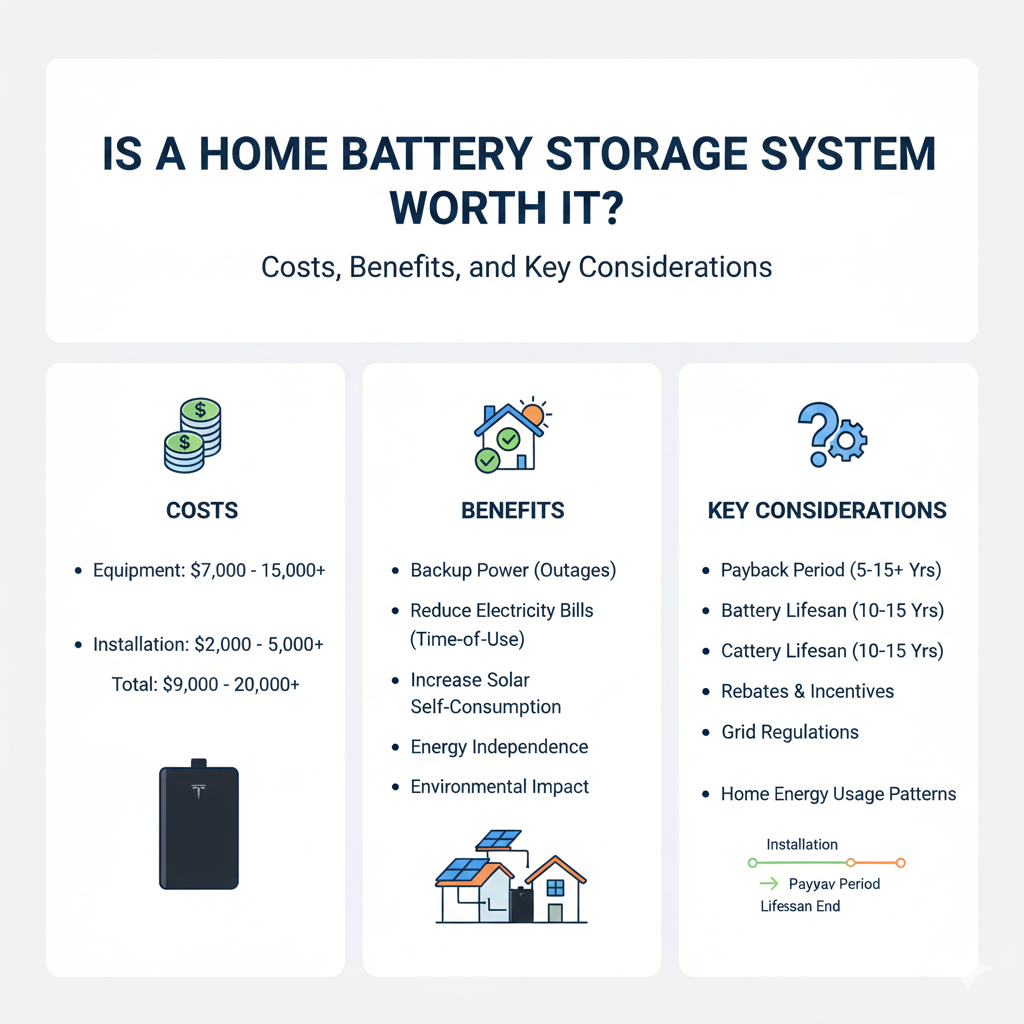
The cost of a home Battery Storage System varies depending on battery capacity, brand, installation complexity, and additional hardware such as inverters or monitoring equipment. Typical residential systems range from US$1,000 to US$8,000 for the battery alone, with full installations reaching US$4,000 to US$12,000. Higher-capacity systems or premium brands naturally fall on the upper end of the range. Solar battery cost also depends on certifications, safety features, and cycle life.
Many installers include labor, wiring, mounting hardware, breakers, communication cables, and configuration in their total price. Homeowners in regions with unstable grids often prioritize reliability, making durable LFP batteries more attractive despite the higher upfront cost. Companies like Hicorenergy, with global production and local delivery networks, provide competitive pricing for both residential and commercial storage, offering long-lasting solutions with over 6,000 cycles and robust safety protections.
Calculating Your Payback Period: When Will a Home Battery Start Saving You Money?
To understand is a home battery worth it, calculating the payback period is essential. Payback depends on electricity tariffs, solar panel generation, battery size, household consumption, and the presence of time-of-use billing. Homes with high evening electricity rates or frequent outages typically recover costs faster. For solar users, storing excess daytime energy reduces the need to buy power from the grid at night, accelerating savings.
A typical payback period ranges from 5 to 10 years, depending on usage and incentives. High-quality batteries with long cycle life ensure that homeowners continue benefiting long after payback is achieved. Selecting an efficient Battery Storage System with >95% round-trip efficiency—such as Hicorenergy’s LFP-based models—can further improve long-term economic returns.
Solar Panels and Battery Storage: Are They a Good Combination?
Solar panels and battery storage work exceptionally well together and are often installed as a package. Solar produces energy only during the day, while a Battery Storage System enables homeowners to use that energy anytime. This combination provides the highest energy independence, lower electricity bills, and protection from outages.
Homes without batteries often waste excess solar or sell it back to the grid at low rates. With a home battery, that energy is stored and used later—maximizing the value of the solar investment. Systems like Hicorenergy’s I-BOX 48100R and C5° are designed specifically to integrate with most inverter brands, enabling reliable solar-plus-storage installations for households and installers.
Key Considerations Before You Buy: Battery Size, Incentives, and Your Energy Goals
Choosing the right Battery Storage System requires evaluating multiple factors. Battery size should match your energy usage patterns and backup requirements. Larger homes or those with essential appliances—such as refrigeration, lighting, or medical devices—may require higher-capacity units. Incentives such as tax credits, rebates, and net-metering policies significantly influence the overall cost, depending on your country or region.
Buyers should also consider installation conditions, temperature tolerance, product certifications, and the reliability of the home battery storage installer. A system with an advanced BMS, remote monitoring, and strong warranties—such as those provided by Hicorenergy—ensures long-term performance. Identifying whether your primary goal is backup power, savings, or full energy independence will help determine the best solution.
Summary
A home Battery Storage System can deliver meaningful savings, energy security, and independence—especially when paired with solar panels. Hicorenergy provides high-quality, long-life residential storage batteries designed for safety, efficiency, and global reliability.
Email: service@hicorenergy.com
WhatsApp: +86 181-0666-0961
-2048x617.png)
 English
  Español
  Deutsch
  Français
  Italiano
  Bahasa Indonesia
  Svenska
  Română
  Українська
  Tagalog