-scaled.png)
-2048x1135-1.png)
Industrial energy storage systems are transforming factories, logistics parks, and commercial facilities by reducing peak demand, stabilizing power supply, and unlocking new revenue streams. This guide explains technology choices, 2026 cost structures, ROI risks, and long-term market trends to help C&I storage investors make data-driven decisions.
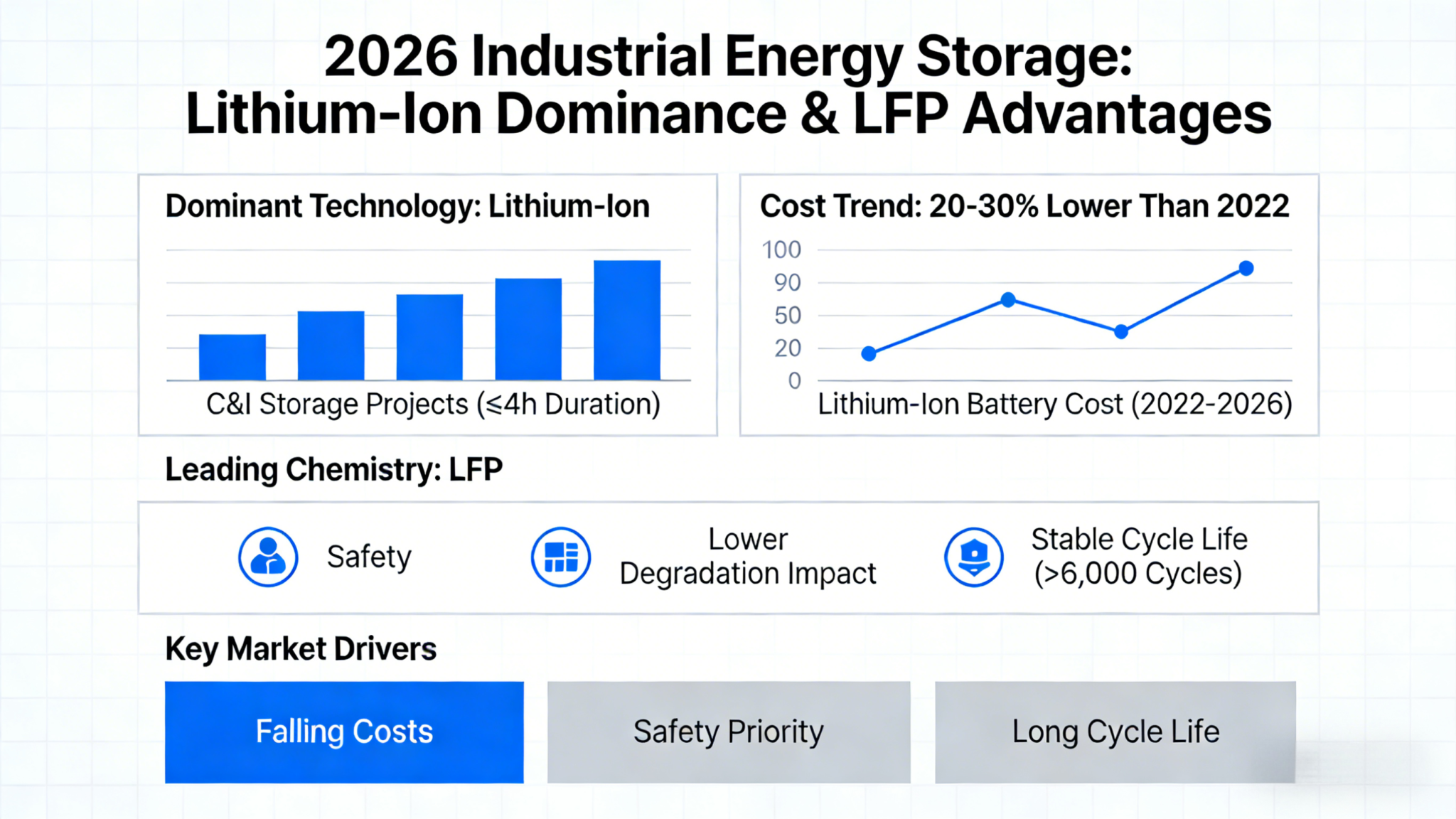
Table of Contents
Lithium-Ion vs. Flow Batteries vs. Thermal Storage: Which Industrial Technology Dominates in 2026?
In 2026, lithium-ion remains the dominant technology in industrial energy storage systems, particularly for C&I storage projects under 4-hour duration. Falling lithium-ion battery cost—now typically 20–30% lower than in 2022—has reinforced its market leadership. Lithium iron phosphate (LFP) chemistry leads due to safety, lower Battery degradation impact, and stable cycle life beyond 6,000 cycles.
Flow batteries, such as vanadium redox systems, are gaining attention for long-duration applications (6–10+ hours). They offer minimal Battery degradation impact over time, but higher upfront CAPEX limits adoption in cost-sensitive projects.
Thermal storage, meanwhile, serves niche industrial processes requiring heat management rather than electricity dispatch. While valuable in specific sectors, it does not directly compete with battery-based industrial energy storage systems in peak shaving or demand response markets.
Overall, lithium-ion dominates in 2026 due to balanced cost, scalability, and performance in mainstream C&I storage deployments.
Breaking Down the 2026 Costs: How Much Does an Industrial Energy Storage System Really Cost?
The cost of industrial energy storage systems in 2026 varies significantly by project size and duration. Average turnkey pricing ranges from USD 250–450 per kWh for standard 2–4 hour lithium-ion C&I storage installations. However, total project cost includes more than battery modules—transformers, PCS, EMS integration, fire suppression, and grid interconnection can account for 35–50% of CAPEX.
Understanding lithium-ion battery cost alone is insufficient. Investors must analyze lifecycle economics, Battery degradation impact, and revenue stacking potential. The following sections explore hidden ROI risks, technical audit failures, and new revenue models shaping industrial energy storage systems performance.
10 Factors Destroying Your Storage ROI
Even well-designed industrial energy storage systems can underperform financially. Ten common ROI risks include:
- Underestimating Battery degradation impact.
- Oversizing systems without accurate load data.
- Ignoring transformer upgrade costs.
- Overly optimistic Peak shaving assumptions.
- Limited tariff volatility.
- Weak EMS optimization.
- Policy uncertainty.
- Inadequate fire compliance planning.
- Poor integration with on-site PV.
- O&M cost escalation.
For example, a 1 MWh C&I storage project targeting Peak shaving may project 25% annual demand charge reduction. However, if load profiles shift or tariff structures change, realized savings may drop below 15%, extending payback by 2–3 years.
Industrial energy storage systems must therefore be modeled with conservative financial assumptions. Advanced EMS software, accurate historical load data, and robust degradation forecasting are essential to protect long-term ROI.
Transformer Capacity & Peak Shaving: Why 30% of Industrial Sites Fail the Pre-Installation Audit
Approximately 30% of proposed C&I storage projects encounter transformer capacity constraints during pre-installation audits. Industrial energy storage systems designed for aggressive Peak shaving can inadvertently exceed transformer backfeed limits, triggering costly upgrades.
For example:
| Audit Issue | Impact on Project |
|---|---|
| Transformer undersized | $50,000–$200,000 upgrade cost |
| Insufficient short-circuit rating | Delayed grid approval |
| Inadequate protection coordination | Compliance rejection |
Peak shaving remains the primary economic driver for industrial energy storage systems. However, without proper transformer assessment and load flow simulation, projected savings may never materialize.
Manufacturers such as Hicorenergy address these challenges with integrated C&I storage solutions like the SI Station 186 (186 kWh air-cooled cabinet) and SI Station 230 (230 kWh liquid-cooled cabinet). These systems are designed for modular expansion, grid compliance, and efficient thermal management—supporting high-demand Peak shaving while simplifying installation planning.

New Revenue Beyond Arbitrage: Capacity Payments, Demand Response, and Virtual Power Plants
While energy arbitrage remains important, industrial energy storage systems in 2026 increasingly rely on stacked revenue models. Demand response programs compensate facilities for reducing load during grid stress events. Capacity markets provide availability payments. Virtual Power Plant (VPP) aggregation enables distributed C&I storage assets to operate as grid resources.
Revenue stacking can increase annual project returns by 15–40%, depending on market rules. For example, a 2 MWh industrial energy storage system participating in Peak shaving plus demand response can achieve faster ROI compared to arbitrage alone.
However, participation requires communication infrastructure, dispatch control, and compliance certifications. Advanced EMS platforms are now standard in modern C&I storage deployments, allowing industrial energy storage systems to operate dynamically across multiple revenue streams.
2026–2035 Outlook: From Short-Duration Lithium to Long-Duration Multi-Technology Hubs
Looking ahead, industrial energy storage systems will evolve from single-technology lithium deployments to hybrid energy hubs. Between 2026 and 2035, short-duration lithium-ion systems will dominate high-power Peak shaving applications, while long-duration storage (flow batteries, hydrogen, thermal) gradually expands grid-level resilience.
Lithium-ion battery cost is projected to decline another 15–25% by 2030, improving economics for 4-hour systems. Meanwhile, Battery degradation impact modeling will become more precise through AI-driven diagnostics, extending usable life.
Future C&I storage facilities may integrate PV, EV charging, backup generation, and industrial energy storage systems into unified microgrids. The shift will redefine industrial energy resilience, enabling facilities to transition from passive consumers to active energy market participants.
Hicorenergy Industrial Energy Storage Solutions
Hicorenergy provides advanced industrial energy storage systems, including SI Station 186 and SI Station 230, engineered for scalable C&I storage, efficient Peak shaving, and global grid compliance. With modular design and strong safety standards, these systems support reliable long-term ROI.
Contact Us
Email: service@hicorenergy.com
WhatsApp: +86 181-0666-0961
-2048x617.png)
 English
  Español
  Deutsch
  Français
  Italiano
  Bahasa Indonesia
  Svenska
  Română
  Українська
  Tagalog