-scaled.png)
-2048x1135-1.png)
Batteries Degrade even when they are not in use—so why does this happen, and what practical steps can you take to protect Lithium-Ion Battery Life during long-term storage? This guide explains the science behind Battery Degradation, the biggest storage risks, and the battery storage tips that truly help extend battery life storage across home, solar, and drone battery storage systems.
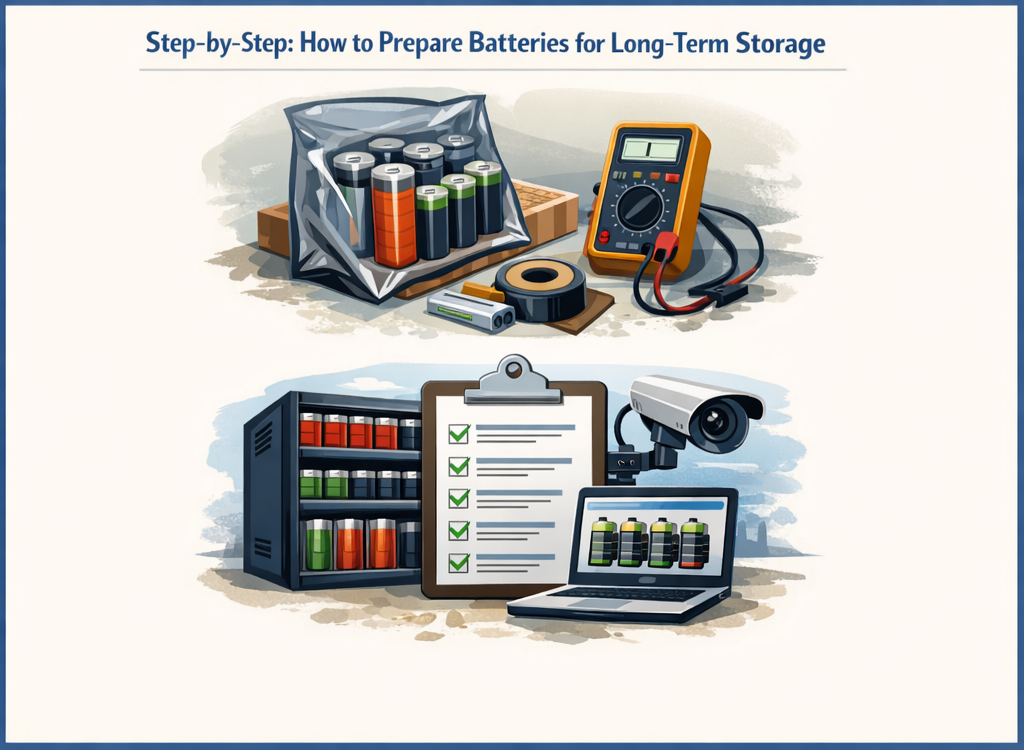
Table of Contents
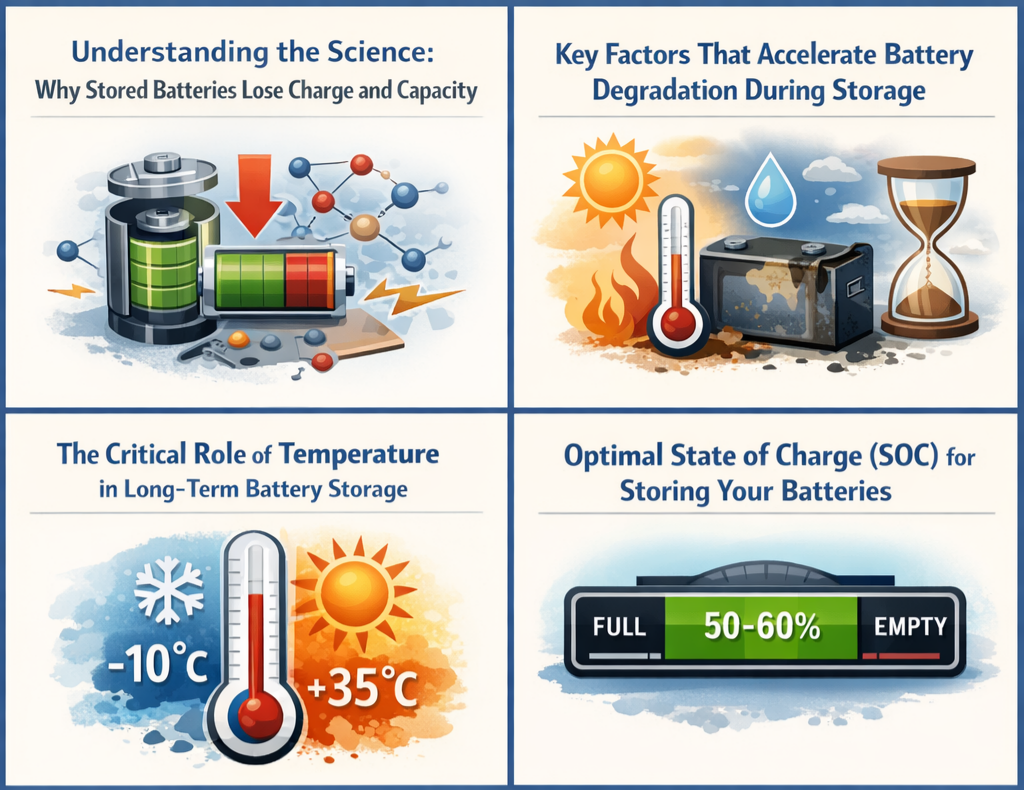
Understanding the Science: Why Stored Batteries Lose Charge and Capacity
Even when powered off, Lithium-Ion batteries are not chemically “asleep.” Inside every cell, slow parasitic reactions continue between the electrolyte, anode, and cathode. These reactions cause Batteries Degrade through two main mechanisms: calendar aging and self-discharge.
According to industry data, lithium batteries can lose 2–5% of their capacity per year in ideal storage conditions—and much more when stored hot or fully charged. As electrolyte decomposes, it forms thicker solid-electrolyte interfaces (SEI), increasing internal resistance and reducing usable capacity. This is why Battery Degradation occurs even without cycling.
Key Factors That Accelerate Battery Degradation During Storage
If Batteries Degrade naturally over time, poor storage makes it much worse. Temperature extremes, high state of charge, humidity, and lack of monitoring all compound Battery Degradation.
In real-world solar battery storage and drone battery storage, many failures come from improper long-term battery storage—units left fully charged in warehouses, garages, or shipping containers. Understanding these risks is the first step to extending Lithium-Ion Battery Life and following a proper battery maintenance guide.
The Critical Role of Temperature in Long-Term Battery Storage
Temperature is the single most powerful driver of Battery Degradation. Every 10°C (18°F) increase roughly doubles the rate of chemical aging inside lithium cells. This means Batteries Degrade far faster in hot environments—even when not used.
| Storage Temperature | Estimated Annual Capacity Loss |
|---|---|
| 15°C (59°F) | ~2% |
| 25°C (77°F) | ~4% |
| 35°C (95°F) | ~8% |
For solar battery storage maintenance, this is critical. Large battery systems like Hicorenergy’s Si LV1 and iBox 48100R are designed with thermal management to keep cells in the ideal 15–25°C range, dramatically reducing Battery Degradation during long-term battery storage.
For smaller systems such as drone battery storage, always store packs in a cool, dry room—not a car, garage, or attic. If Batteries Degrade due to heat, the lost capacity can never be recovered.
Optimal State of Charge (SOC) for Storing Your Batteries
Another major reason Batteries Degrade is improper state of charge during storage. Keeping lithium batteries at 100% SOC stresses the cathode, while storing them empty risks deep discharge damage.
The sweet spot for extend battery life storage is 40–60% SOC. At this level, the internal voltage is low enough to reduce electrolyte oxidation, yet high enough to avoid copper dissolution on the anode.
Research from battery labs shows that lithium cells stored at 100% SOC at 25°C can lose twice as much capacity in one year compared to those stored at 50%.
This applies to everything from solar battery storage maintenance to drone battery storage. Hicorenergy’s battery management systems in products like Si LV1 automatically optimize SOC during idle periods, helping reduce Battery Degradation without user intervention.
Step-by-Step: How to Prepare Batteries for Long-Term Storage
A proper battery maintenance guide should always include preparation steps before long-term battery storage. Here’s how professionals do it:
- Discharge or charge the battery to 40–60% SOC
- Power off and isolate the battery from inverters or loads
- Clean terminals to prevent corrosion
- Store in a temperature-controlled environment (15–25°C)
- Use protective packaging to avoid moisture and dust
For large-scale systems such as Hicorenergy’s iBox 48100R, built-in BMS and modular design allow sections to be safely isolated for storage, reducing risk and Battery Degradation. Skipping these steps is one of the main reasons Batteries Degrade prematurely in warehouses and project sites.
Maintenance and Monitoring Checklist for Stored Battery Systems
Even in storage, batteries need periodic attention. A strong battery maintenance guide includes routine checks to slow Battery Degradation.
Every 3–6 months, you should:
- Check SOC and recharge to 50% if it drops below 30%
- Inspect for swelling, corrosion, or moisture
- Verify temperature remains in the safe range
- Log voltage trends to detect early Battery Degradation
Data shows that batteries left unmonitored can suffer irreversible deep discharge within 12–18 months. Hicorenergy’s smart energy storage systems provide remote monitoring, making solar battery storage maintenance easier and more reliable—even when units are stored before deployment.
Final Thoughts from Hicorenergy
Batteries Degrade, but smart storage dramatically extends Lithium-Ion Battery Life. With controlled temperature, proper SOC, and intelligent monitoring, Hicorenergy solutions like Si LV1 and iBox 48100R help minimize Battery Degradation and protect your investment.
Contact us for tailored battery storage tips and professional solutions:
📧 Email: service@hicorenergy.com
📱 WhatsApp: +86 181-0666-0961
-2048x617.png)
 English
  Español
  Deutsch
  Français
  Italiano
  Bahasa Indonesia
  Svenska
  Română
  Українська
  Tagalog