Day: December 11, 2025

  • Is a Home Battery Storage System Worth It? Costs, Benefits, and Key Considerations

    Is a Home Battery Storage System Worth It? Costs, Benefits, and Key Considerations

    A home Battery Storage System helps households store electricity for later use, reduce grid dependence, save on energy bills, and ensure reliable backup power. This article explains how home battery systems work, their costs, benefits, payback period, and key factors to consider before buying.

    Home Battery Storage System

    What Is a Home Battery Storage System and How Does It Work?

    A home Battery Storage System is a device that stores electricity for use when grid power is unavailable or when energy prices are high. It works by capturing excess energy—often from solar panels—and storing it in lithium-ion batteries for later consumption. When solar generation drops or a power outage occurs, the home battery automatically supplies backup power to essential loads. Modern systems include intelligent Battery Management Systems (BMS) and monitoring software that optimize charging, discharging, and long-term battery health. Brands like Hicorenergy manufacture advanced lithium iron phosphate (LFP) systems designed for reliability, long cycle life, and compatibility with major inverters. These systems ensure stable performance in residential environments and support various applications such as backup power, off-grid use, peak shaving, and zero-export configurations.

    Key Benefits of Installing a Home Battery: Energy Independence, Savings, and Backup Power

    Installing a home Battery Storage System offers households greater energy independence, bill savings, and enhanced resilience during outages. When combined with solar, it allows homeowners to store daytime solar production for nighttime use, maximizing self-consumption. These benefits make many readers want to explore if a home battery is worth it for their specific needs.

    The Real Cost of Home Battery Storage Systems: Installation and Equipment Prices

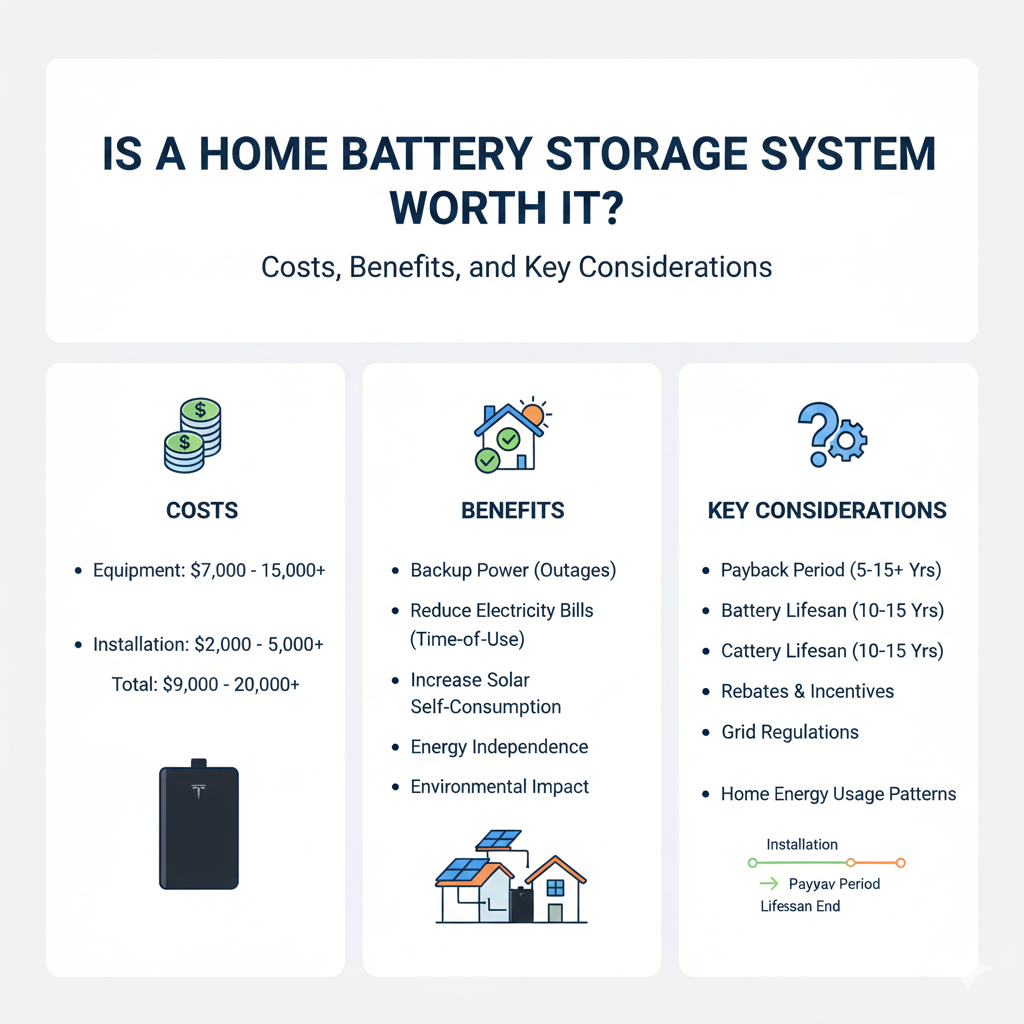
    The cost of a home Battery Storage System varies depending on battery capacity, brand, installation complexity, and additional hardware such as inverters or monitoring equipment. Typical residential systems range from US$1,000 to US$8,000 for the battery alone, with full installations reaching US$4,000 to US$12,000. Higher-capacity systems or premium brands naturally fall on the upper end of the range. Solar battery cost also depends on certifications, safety features, and cycle life.

    Many installers include labor, wiring, mounting hardware, breakers, communication cables, and configuration in their total price. Homeowners in regions with unstable grids often prioritize reliability, making durable LFP batteries more attractive despite the higher upfront cost. Companies like Hicorenergy, with global production and local delivery networks, provide competitive pricing for both residential and commercial storage, offering long-lasting solutions with over 6,000 cycles and robust safety protections.
    Home Battery Storage System

    Calculating Your Payback Period: When Will a Home Battery Start Saving You Money?

    To understand is a home battery worth it, calculating the payback period is essential. Payback depends on electricity tariffs, solar panel generation, battery size, household consumption, and the presence of time-of-use billing. Homes with high evening electricity rates or frequent outages typically recover costs faster. For solar users, storing excess daytime energy reduces the need to buy power from the grid at night, accelerating savings.

    A typical payback period ranges from 5 to 10 years, depending on usage and incentives. High-quality batteries with long cycle life ensure that homeowners continue benefiting long after payback is achieved. Selecting an efficient Battery Storage System with >95% round-trip efficiency—such as Hicorenergy’s LFP-based models—can further improve long-term economic returns.

    Solar Panels and Battery Storage: Are They a Good Combination?

    Solar panels and battery storage work exceptionally well together and are often installed as a package. Solar produces energy only during the day, while a Battery Storage System enables homeowners to use that energy anytime. This combination provides the highest energy independence, lower electricity bills, and protection from outages.

    Homes without batteries often waste excess solar or sell it back to the grid at low rates. With a home battery, that energy is stored and used later—maximizing the value of the solar investment. Systems like Hicorenergy’s I-BOX 48100R and C5° are designed specifically to integrate with most inverter brands, enabling reliable solar-plus-storage installations for households and installers.

    Key Considerations Before You Buy: Battery Size, Incentives, and Your Energy Goals

    Choosing the right Battery Storage System requires evaluating multiple factors. Battery size should match your energy usage patterns and backup requirements. Larger homes or those with essential appliances—such as refrigeration, lighting, or medical devices—may require higher-capacity units. Incentives such as tax credits, rebates, and net-metering policies significantly influence the overall cost, depending on your country or region.

    Buyers should also consider installation conditions, temperature tolerance, product certifications, and the reliability of the home battery storage installer. A system with an advanced BMS, remote monitoring, and strong warranties—such as those provided by Hicorenergy—ensures long-term performance. Identifying whether your primary goal is backup power, savings, or full energy independence will help determine the best solution.

    Summary

    A home Battery Storage System can deliver meaningful savings, energy security, and independence—especially when paired with solar panels. Hicorenergy provides high-quality, long-life residential storage batteries designed for safety, efficiency, and global reliability.

    Email: service@hicorenergy.com
    WhatsApp: +86 181-0666-0961

    Home Battery Storage System
  • Top 5 Energy Storage Technologies by Efficiency & Where They’re Used Today

    Top 5 Energy Storage Technologies by Efficiency & Where They’re Used Today

    Energy storage systems differ widely in performance, but the most efficient energy storage technologies share one trait: high round-trip efficiency. This article compares the top five technologies, explains where each is used today, and helps readers understand how to choose the right solution for real-world applications.

    Energy Storage Technologies

    Why Energy Storage Efficiency Matters More Than Ever

    Energy storage efficiency has become a defining factor in renewable energy integration, grid stability, and the economics of modern power systems. As more households, industries, and utilities shift toward clean energy, the most efficient energy storage solutions reduce electricity losses, lower long-term costs, and stabilize power supply in regions with unreliable grids. Today, efficiency is essential not only for solar-powered homes and grid-scale battery storage but also for electric vehicles and large renewable energy projects seeking reliable long-duration storage.

    Understanding Round-Trip Efficiency in Energy Storage

    Round-trip efficiency (RTE) measures how much stored energy can be used after charging and discharging. A system with 90% RTE returns 90 units of energy for every 100 units stored. Higher RTE means lower losses, making the search for the most efficient energy storage options crucial for both consumers and grid operators.

    The Efficiency Leaderboard: Top 5 Technologies Compared

    Below is a simplified comparison chart showing general round-trip efficiency ranges:

    TechnologyTypical RTEPrimary Use
    Lithium-Ion90–98%Homes, EVs, C&I, grid-scale
    Pumped Hydro70–85%Bulk grid storage
    Flywheel85–95%Frequency regulation
    CAES45–70%Large-scale long-duration
    Flow Batteries70–85%Renewable integration, long-duration

    1. Lithium-Ion Batteries: The High-Efficiency All-Rounder

    Lithium-ion batteries remain the most efficient energy storage option available today, reaching up to 98% round-trip efficiency. Their compact size, long service life, and falling costs make them ideal for residential, commercial, and grid-scale applications. They dominate electric vehicles and grid-scale battery storage projects because they deliver consistent performance, high energy density, and strong cycle life.

    Many global integrators rely on lithium-ion systems for renewable energy integration due to their fast response and adaptability in unstable grids. Companies like Hicorenergy offer advanced lithium battery storage solutions—including the I-BOX 48100R and the C5° series—featuring >95% round-trip efficiency and 6000+ cycles, making them reliable choices for regions requiring maintenance-free, high-efficiency performance.

    2.Pumped Hydro Storage: The Established Bulk Power Champion

    Pumped hydro storage provides the largest energy storage capacity globally, often exceeding hundreds of megawatt-hours per site. With a typical efficiency range of 70–85%, it remains vital for grid stability, long-duration support, and balancing renewable generation. Although less efficient than lithium-ion batteries, it excels at storing massive amounts of energy for hours or days. The technology requires specific geography—elevation differences and abundant water—which limits its widespread deployment. Nonetheless, it remains the backbone of national grids seeking affordable long-duration storage.

    3.Flywheel Energy Storage: For Unmatched Power and Instant Response

    Flywheel systems store energy mechanically and achieve efficiencies between 85–95%. Their ability to deliver power almost instantly makes them ideal for frequency regulation, stabilizing microgrids, and supporting critical infrastructure. While their energy capacity is relatively low, their near-infinite cycling capability gives them an advantage in applications requiring rapid charge/discharge. Flywheel storage plays a crucial role in data centers, transport systems, and industrial operations requiring precise power quality control.

    4. Compressed Air Energy Storage (CAES): Large-Scale, Long-Duration Potential

    CAES systems hold promise for long-duration storage at the utility scale. Traditional CAES achieves 45–55% efficiency, but advanced adiabatic CAES can reach up to 70%. These systems store compressed air in underground caverns and release it through turbines when power is needed. Though less efficient, CAES’s low operating cost and ability to integrate with renewable energy make it attractive for countries seeking low-carbon grid solutions. Its deployment requires suitable geology, limiting its global adoption.

    5.Flow Batteries: Efficient Long-Duration Storage for Renewables

    Vanadium redox flow batteries typically achieve 70–85% efficiency and offer virtually unlimited cycle life. Their long-duration capability makes them suitable for solar and wind farms requiring multi-hour storage. Unlike lithium-ion batteries, their energy capacity is independent of power capacity, allowing flexible scaling. Flow batteries are becoming increasingly relevant for long-duration storage strategies that support renewable energy integration and grid stability in remote or weather-dependent regions.

    Energy Storage Technologies

    Beyond Efficiency: Key Factors in Choosing a Storage Technology

    While the most efficient energy storage solutions seem appealing, choosing the right system also depends on cost, installation space, safety, cycle life, temperature tolerance, and maintenance requirements. For example, lithium-ion batteries excel in compactness and reliability, while pumped hydro and CAES remain better suited for bulk, long-duration applications. For households and small businesses, products like Hicorenergy’s Si LV1 and SHV48100 offer scalable, safe, and easy-install lithium storage systems designed for unstable grids and peak-shaving applications.

    The Future of Efficient Storage: Emerging Technologies to Watch

    Solid-state batteries, thermal energy storage systems, and hydrogen-based solutions are rapidly advancing. Solid-state batteries may exceed the efficiency and safety of today’s lithium-ion systems, while thermal energy storage promises cost-effective solutions for industrial heating and cooling. These innovations aim to push the boundaries of the most efficient energy storage technologies and improve long-duration performance.

    Matching the Right Technology to Real-World Needs

    Homes with solar panels require compact, high-efficiency lithium solutions; utilities managing large renewable farms need flow batteries or pumped hydro; and industrial sectors may benefit from flywheels or CAES. Matching technology to application ensures the best balance of efficiency, cost, longevity, and grid stability.

    Hicorenergy provides high-efficiency lithium energy storage systems for residential, commercial, and industrial users worldwide, supporting reliable renewable integration and long-duration storage needs.

    Email: service@hicorenergy.com | WhatsApp: +86 181-0666-0961

    Energy Storage Technologies
en_USEnglish